
- Blogs
Why BRSR is Redefining Sustainability Reporting in India for 2025

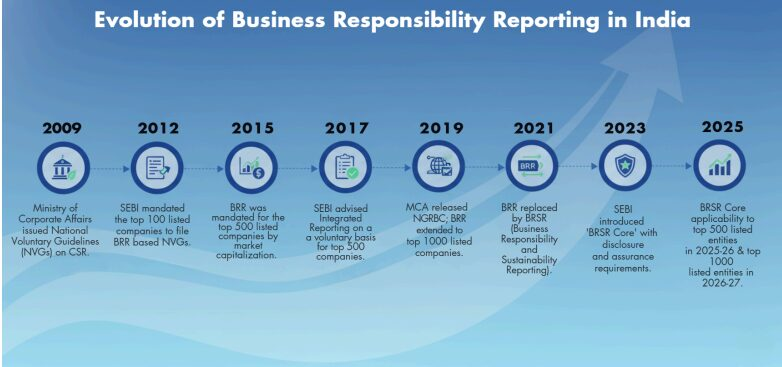
Evolution of Sustainability Reporting in India (Timeline)
India’s sustainability landscape is undergoing a pivotal shift. The Business Responsibility and Sustainability Reporting (BRSR) framework, introduced by the Securities and Exchange Board of India (SEBI), is no longer a disclosure format, it is transforming how companies think about accountability and long-term value creation by disclosing environmental, social, and governance (ESG) metrics. Originally voluntary, BRSR became mandatory for the top 1,000 listed companies in fiscal year 2022–23. As of 2025, it continues to evolve, setting new standards for accountability, value chain transparency, and data assurance.
Key updates:
- Quantitative and Qualitative Disclosures:
BRSR requires companies to provide both quantitative metrics and qualitative disclosures across nine principles derived from the National Guidelines on Responsible Business Conduct (NGRBC). This dual approach ensures a comprehensive understanding of a company’s ESG performance.
- Value Chain Reporting:
Starting from fiscal year 2025–26, companies must disclose ESG data from their value chain partners representing at least 2% of purchases or sales, covering up to 75% of total value chain activities. This extended reporting obligation aims to provide a holistic view of a company’s environmental and social impacts.
- Assurance Requirements:
SEBI has introduced the option for companies to assess or verify their BRSR core disclosures. Mandatory third-party verification will begin with the top 500 listed companies in fiscal year 2025–26, expanding to the top 1,000 in fiscal year 2026–27. This phased approach allows companies time to strengthen their internal systems and build capacity for accurate reporting.
- Green Credit Program:
Under Principle 6 (environmental stewardship), SEBI has introduced the option for companies and their top ten value chain partners to earn green credits for measurable environmental activities such as afforestation on degraded lands and river catchment restoration. This initiative aligns corporate reporting with India’s broader climate and biodiversity goals. Strategic Implications for Businesses.
- Enhanced Transparency:
BRSR’s structured framework enhances transparency, enabling stakeholders to assess a company’s ESG performance more effectively.
- Investor Confidence:
Robust ESG disclosures can attract investors who are increasingly prioritizing sustainability in their investment decisions.
- Regulatory Compliance:
Adhering to BRSR ensures compliance with SEBI’s regulations, mitigating legal and reputational risks.
- Competitive Advantage:
Companies that proactively embrace BRSR can differentiate themselves in the market, showcasing their commitment to sustainable practices.
Ref:

