
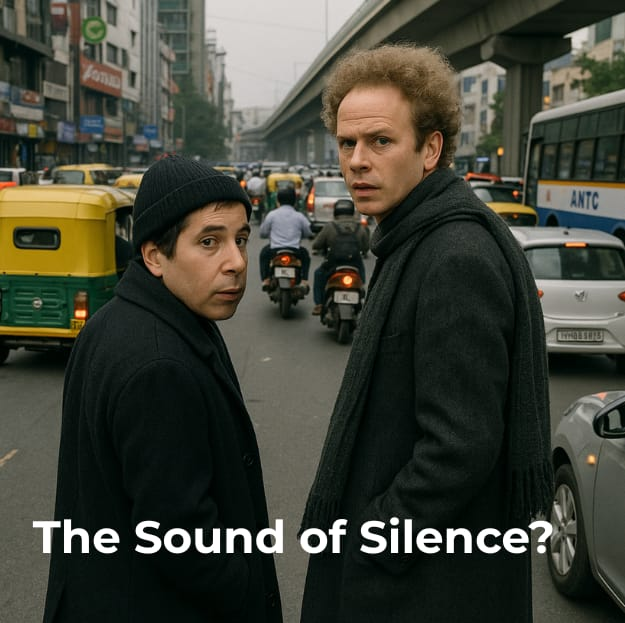
“Hello darkness, my old friend.”
The opening line of Simon and Garfunkel’s The Sound of Silence still feels hauntingly current. It is a song about loneliness, but also about awareness. It reminds us that in silence, we truly begin to listen.
Silence is where presence begins. It is where we can hear life breathing around us. Yet today, silence has almost vanished.
Homo sapiens urbanis
I have been fortunate enough to experience absolute, pin-drop silence. In those moments, even your heartbeat feels loud, and the sound of your breath is the most audible rhythm. It is in that stillness that you perceive the sound of silence itself. But our species, Homo sapiens urbanis, may never know this feeling again.
Step outside and silence feels extinct. Our daily soundscape is an endless mix of horns, engines, and voices that never pause.
The Lost Sound of Togetherness
Every time I go out, it is usually to savour good food in the company of people I love, whether friends, family, or colleagues. Yet more often than not, we end up shouting over background music that should have stayed in the background.
Personally, I seek restaurants that play soft music, where you can hear your food, your thoughts, and each other. These spaces are rare. When I am with younger people, they sometimes find my preference odd. To them, noise seems lively. To me, calm feels real.
It is even more peculiar in gyms. They focus so much on building strength that they forget about protecting hearing. Loud music is treated as motivation, but it harms more than it helps.
Even weddings, parties, and corporate events have become sound contests. Volume is mistaken for energy, shouting for joy.
The Numbers Behind the Noise:
Noise pollution is not just an irritation. It is a public-health issue. The World Health Organization warns that long-term exposure above 55 decibels by day or 45 decibels at night can cause stress, hypertension, and heart disease.
Yet daily life exceeds those limits easily.
- Traffic in cities: 90 to 100 decibels
- Gyms and cafés: 80 to 95 decibels
- Weddings and concerts: 100 to 110 decibels
Anything above 70 decibels over time can damage hearing. For those who live or work on roads, such as drivers and traffic police, this is not an occasional noise. It is their everyday environment.
If you want to know what your ears endure, try a free phone app that shows live sound levels. The numbers can be eye-opening.
The Meaning of Silence
When Paul Simon wrote The Sound of Silence, he was reflecting on how people were talking without listening and hearing without understanding. That message fits today’s cities perfectly.
We have confused noise with energy and volume with value. Yet silence is not the absence of life. It is what gives life its shape.
A restaurant can be vibrant without being loud. A gym can be motivating without being deafening. A wedding can be joyous without being overwhelming. Quiet does not mean dull. It means deliberate.
If we paused to listen, we would realise that silence is not emptiness. It is depth.
Rediscovering the Sound of Silence
We have normalised the hum of chaos. But peace is not a privilege. It is part of health, focus, and connection.
Next time we eat out, exercise, or plan an event, let us choose calm. Ask for the music to be softer. Drive without honking. Notice the difference it makes.
Because when we strip away the noise, something remarkable appears: awareness, empathy, and life itself.
That is the sound Paul Simon was really writing about.
And that is the sound we need to hear again.

