
- Blogs
Mapping Your SDG Impact: Why Businesses Need More Than Lip Service to the Global Goals
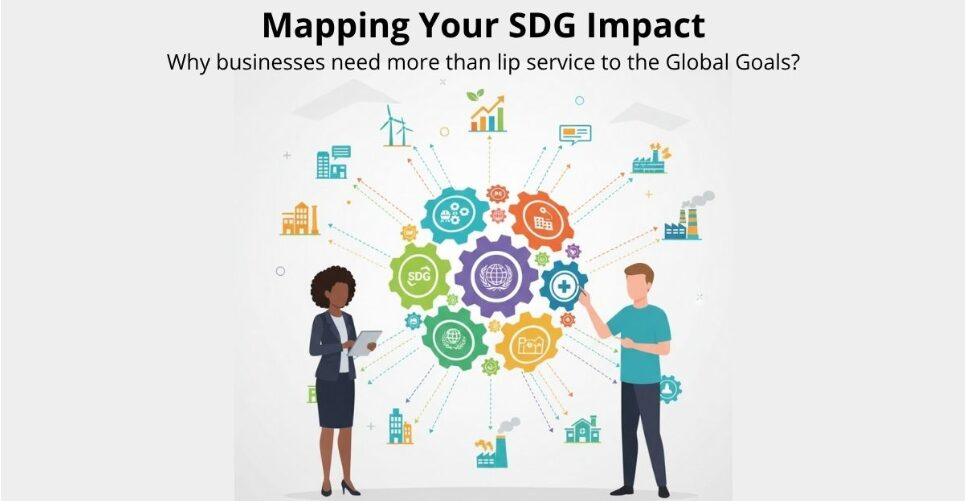
When it comes to the Sustainable Development Goals (SDGs), corporate pledges are usually loud, but the actual impact often whispers. It’s the classic case of aspirational declarations overshadowing difficult realities.
Since the Global Goals were established in 2015, businesses have eagerly aligned their brands with the world’s most pressing challenges ranging from poverty and hunger to climate action and equality. However, eight years into the 2030 Agenda, the gap between the glossy sustainability reports and verifiable, on-the-ground change is widening.
For companies, this isn’t just an issue of ethics; it’s an existential risk. A business that only pays lip service to the SDGs is building its future on an inaccurate foundation. The only way forward is to stop marketing impact and start mapping it.
The Global Diagnosis: Symptoms of a Bigger Problem
The UN’s 17 goals serve as the world’s urgent risk register, yet many corporate sustainability efforts currently act as a form of geopolitical distraction. Like a minor skirmish that signals deeper tensions, the following symptoms expose a fundamental disconnect between corporate talk and true commitment:
1. The ‘Signal vs. Substance’ Illusion
This is the most visible and cynical symptom of lip service. It’s when a company heavily signals its commitment to an SDG (e.g., placing the SDG logos prominently on its website) but lacks the substance, the significant investment and material change behind the scenes.
In academic and reporting circles, this behavior is increasingly categorized. The company is either “profit-masking” and using a veneer of purpose to maintain traditional, profit-maximization practices or engaging in outright greenwashing. The key failure here is the absence of an accurate map linking business operations directly to measurable social or environmental change.
For instance, announcing a commitment to “gender equality” (SDG 5) while failing to disclose the gender pay gap or track the percentage of women in senior leadership is mere signaling. The measurable symptom here is the continued pay disparity or the stagnant leadership diversity. The underlying cause is the failure to integrate the goal into core HR and governance metrics.
2. The Measurement and Data Gap
If a company is truly committed to change, it will establish clear metrics and accountability. When impact is not mapped, it cannot be managed.
The ongoing struggle with SDG impact measurement is the corporate world’s “2008 financial crisis”. The resulting chaos is brewing because unaudited, opaque SDG data is being bundled into “sustainable” assets, with no universal accounting standard to verify their true value. Companies struggle to navigate a fragmented landscape of reporting frameworks (GRI, SASB, TCFD, etc.).
This complexity often leads to what we can call the Measurement Gap:
- Failure to Define Thresholds: Many companies report on activities but avoid defining a clear threshold for positive, neutral, or negative impact. It’s easy to report on total water used; it’s much harder to set a target for a positive water impact in a water-stressed region (SDG 6).
- Inconsistent Data: Multinational corporations find it nearly impossible to collect standardized, comparable data across different jurisdictions and value chains, resulting in fragmented and often non-material disclosures.
Without an accurate system to quantify performance such as tracking Scope 1, 2, and 3 emissions for Climate Action (SDG 13) or waste-to-landfill for Responsible Consumption (SDG 12), commitments remain qualitative aspirations, not quantitative targets.
The Path to Genuine Mapping
Moving beyond lip service is not about having a bigger marketing budget; it’s about having a better blueprint. For leaders ready to transition from vague commitment to genuine action, the process requires three structured steps:
- Prioritize Materiality, Not All 17: Stop claiming to support all 17 SDGs. A scattered focus dilutes resources. Instead, conduct a materiality assessment to identify the 3-5 goals your core business activities most significantly impact, both positively and negatively. If you’re a financial institution, your most material goals are likely Decent Work (SDG 8) and Climate Action (SDG 13) through your investment portfolio, not eliminating hunger (SDG 2).
- Integrate Goals into the Core Business Logic: An SDG commitment must be tied to Capital Investment and Executive Compensation. If a CEO’s annual bonus is linked to reducing waste (SDG 12) or increasing diverse leadership (SDG 5), that goal instantly shifts from a CSR initiative to a business imperative.
- Establish a Robust Impact Map: Use existing, structured methodologies (like the UN Global Compact’s tools) to create a framework that links activities to quantitative KPIs. This map must clearly outline the data source, the metric, the performance threshold, and the target year. This process turns a nebulous goal like “sustainable sourcing” into a measurable target: “90% of all critical suppliers covered by science-based emission reduction targets by 2026.”
- Report on Specific Indicators, Not Just Outcomes: Do not simply attach SDG logos to your finished products or services. True commitment means drilling down to the specific SDG Indicators (there are 231 unique indicators) that measure progress. For example, instead of broadly supporting “Quality Education” (SDG 4), report on Indicator 4.4.1: “Proportion of youth and adults with information and communications technology (ICT) skills, by type of skill.” This shifts the focus from a general claim to a specific, measurable data point.
Conclusion: Avoiding the Global Mishap
Tension is increasing in a world facing unprecedented ecological, social, and economic disruption. The failure of businesses to genuinely map and act on their SDG impact is not a failure of sustainability; it is a failure of risk management.
The SDGs represent a deadline for global stability. Every vague report, every unverified claim, is a missed opportunity to build the resilience needed for a viable future. Taking extra precautions now by demanding and delivering measurable and mapped impact is always better than facing a global mishap that could further destabilize the economies we operate in.
True leadership is not about boasting your purpose; it’s about quietly and accurately mapping the distance between your operations and a sustainable world

