
Beyond Scope 1 & 2- Why Scope 3 emissions Are Your Greatest Climate risk
- Varun Dwivedi
- Sustainability Analyst Intern
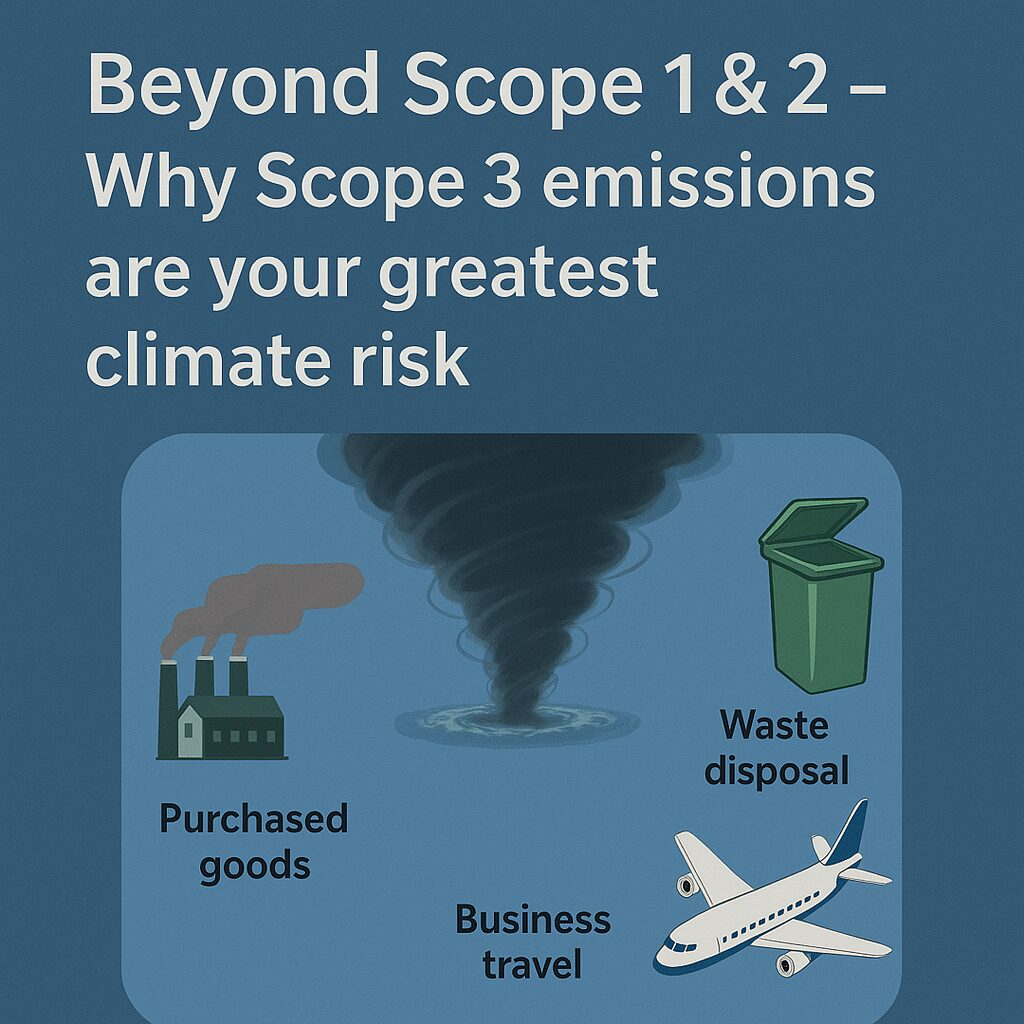
Climate Science has been there for nearly half a century and even when things were getting understood at global forums, and the responsibilities were being allocated for nation states (i.e. Kyoto Protocol), the entire focus was on Scope 1 and Scope 2 emissions. This was because no one could even think of tackling Scope 3 emissions, and then Kyoto slipped, some milestones were achieved, and we can really see that after a lost decade, in 2015 Paris treaty solidified at least the scope of actions. One of those concrete actions is to extend the scope of emissions to be tackled to value chain or Scope 3 emissions.
From operational control to value chain Accountability
The Greenhouse Gas Protocol introduced Scope 3 emissions to understand upstream and downstream emissions of a company’s operations. It acknowledged the fact that no businesses operate in silos. Every transaction, material and product is part of a complex web of interdependent value chains.
This shift in the approach actually mirrors the evolution of the concept of sustainability itself, from a fragmented component level view, to a nuanced systemic level understanding.
While Scope 1 and Scope 2 measure accountability by ownership and control, Scope 3 emissions reframe this approach with an emphasis on interconnection. This approach highlights that companies view emissions not only as an efficiency issue but as a shared responsibility across industries and ecosystems.
The Hidden Majority
For a majority of energy intensive sectors, Scope 3 emissions account for 70-95% of total emissions.
Yet these emissions remain largely invisible when it comes to corporate disclosures.
This blindspot is actually dangerous. By focusing narrowly on only operational emissions- Companies underestimate their increasing risk tied with rising energy costs, material constraints, and policy shifts.
Products with high use face emissions stand at the risk of becoming stranded in low carbon markets. Investors also see undisclosed Scope 3 emissions as latent liabilities that can potentially threaten the long-term value of a company.
Why Scope 3 are your greatest risk
- Scale without control
Scope 3 emissions, although large in scale, lie outside the direct control of management. They are dependent on a number of suppliers, distributors and customers whose actions influence a company’s carbon footprint. This diffusion of responsibility creates complexity in decarbonisation efforts and in turn magnifies, reputational and operational risk when partners fail to decarbonise. - Transitional and Financial risk
As carbon pricing, reporting mandates and trade regulations expand- embedded emissions will translate into cost volatility. Companies unable to map or mitigate these emissions would end up facing shrinking margins and higher financing costs. - Reputational and Regulatory pressure
Frameworks like corporate sustainability reporting directive (CSRD) and Science Based Targets initiative (SBTi) now make Scope 3 disclosure and target setting essential. Investors and regulators judge a company not only by its own operations rather by the integrity of its entire value chain. Ignoring scope 3 emissions can actually trigger a credibility crisis. - Data Blind Spots
There is no consistency of data in scope of the emissions as they rely majorly on estimates and supplier inputs. Inconsistent reporting and opaque methodologies leave blind spots in Scope 3 disclosures. Inconsistent and unreliable data can create further complexity in Scope 3 disclosure.
Beyond Measurement: Turning Scope 3 into Sustainability Strategy
Addressing Scope 3 emissions is not simply a technical challenge, rather it’s a strategic shift. It broadens a company’s sustainability strategy by actively including procurement, product design, customer engagement and capital allocation. If we look at what some leading corporates do:
- Unilever has embedded carbon footprint criteria in supplier contracts.
- Apple requires its suppliers to transition 100% renewable electricity.
- IKEA uses product innovation with circular designs to cut life-cycle emissions.
All these practices are based on the same truth that scope 3 reduction builds resilience and competitiveness, not just compliance.
Why do many companies still fall short?
Despite the growing awareness, the majority of corporate efforts are reactive in nature. This happens due to:
- Generic emission factors: relying on averages instead of supplier specific data, which does not reflect action taken on the ground
- Governance disconnect: failure in integrating scope 3 emissions in financial planning and board oversight.
- Short-term fixes: prioritising immediate offsets over structural value chain redesign.
What beyond Scope 1 & Scope 2 looks like
To lead in the next phase of corporate climate strategies, companies need to involve Scope 3 in the core of business decision-making, this would require:
- Mapping and Prioritizing: Identifying the suppliers and categories that drive emissions using life-cycle and input output data.
- Engaging and Empowering: Actively engaging and equipping suppliers with incentives and tools to support decarbonisation.
- Setting Science-Based Targets: Setting reduction targets aligned with SBTi guidance, Including supplier engagement as a goal.
- Integrating Scope 3 in governance: Embedding scope 3 oversight in executive KPIs, board risk frameworks and procurement policies.
- Being transparent: Clearly disclosing all data progress and assumptions. Transparency is what actually builds investor trust and confidence.
From Risk to Resilience
The conversation on climate responsibility is evolving and it is shifting from control to influence. Scope 3 emissions are at the heart of this evolution. They reflect a shift from a narrow view of sustainability to a more nuanced understanding that businesses and their impact are interconnected in nature.
Thus, managing Scope 3 emissions effectively turns climate risk into strategic foresight. Companies which effectively address the Scope 3 challenge would in turn be strengthening their supply security, customer loyalty, and investor trust.
Through transparency, science based action and supplier collaboration, this greatest climate risk can be turned into an opportunity.

