

Why GHG Accounting is your first step towards Net Zero in 2026
- Anamika Soni
- Senior Sustainability Associate
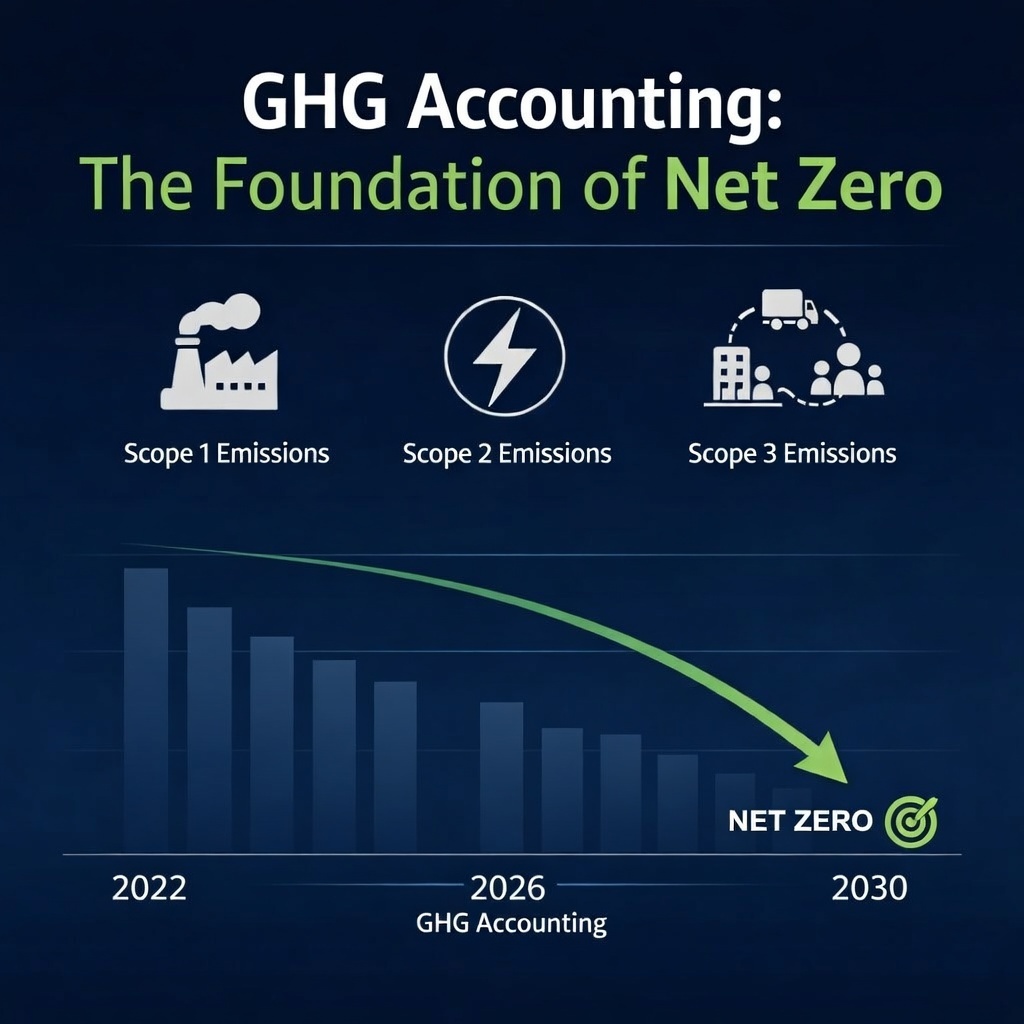
Whether or not an organisation understands the science of climate change or its impact, GHG accounting has entered organisational spheres and is here to stay. Governments, investors, customers, and supply-chain partners increasingly expect climate commitments to be supported by credible data, transparent reporting, and verifiable progress. At the centre of this shift lies one foundational requirement: greenhouse gas (GHG) accounting, which is therefore not a reporting formality.
GHG accounting is the starting point of any credible net-zero journey, enabling organisations to move from high-level ambition to concrete, accountable action.
Understanding GHG Accounting
Greenhouse gas (GHG) accounting, also called carbon accounting, refers to measuring and monitoring GHG emissions using standardized methods and reporting them in accordance with agreed-upon protocols.
The origin of greenhouse gas (GHG) accounting, or measuring emissions from companies and other entities, dates to the late 1990s, but interest has grown exponentially in the past few years with the proliferation of both voluntary and, more recently, mandatory corporate climate disclosure initiatives. GHG emissions disclosure is a critical climate change mitigation and accountability tool, as well as a key step towards achieving ambitious emissions-reduction goals. The process to achieve these GHG emissions reductions starts with GHG accounting.
The key components of GHG accounting include:
- Emission Scopes: Emissions are categorised into Scope 1 (direct emissions from owned or controlled sources), Scope 2 (indirect emissions from purchased electricity), and Scope 3 (all other indirect value-chain emissions).
- Standardised Frameworks: Emissions are quantified and reported using recognised standards such as the GHG Protocol and the ISO, ensuring consistency and transparency.
- Reporting and Verification: Emissions data is recorded systematically and, where required, independently verified to ensure accuracy and credibility.
Why GHG Accounting Matters More Than Ever
To avoid the worst impacts of climate change, global greenhouse gas emissions need to drop by nearly half by 2030 and ultimately reach net zero.
These are some of the key reasons why GHG Accounting is important:
- Regulatory Readiness: Meets evolving disclosure requirements.
- Credible Baseline: Establishes accurate emissions baselines.
- Emissions Hotspots: Identifies priority reduction areas.
- Target Setting: Enables science-based targets and net-zero pathways.
- Strategic Planning: Informs operational and investment decisions.
- Value-Chain Engagement: Drives supplier and partner action.
- Data Assurance: Ensures auditable, verification-ready data.
- Market Access: Unlocks sustainable finance and procurement.
- Risk Management: Mitigates regulatory and transition risks.
- Performance Tracking: Supports year-on-year progress measurement.
Regulatory and Policy Momentum Across Countries
Governments and regulators are increasingly embedding GHG accounting into mandatory disclosure and compliance frameworks. The European Union’s Corporate Sustainability Reporting Directive (CSRD) requires large companies and listed SMEs to disclose standardised, auditable information on greenhouse gas emissions and climate risks under the European Sustainability Reporting Standards (ESRS). In the United States, the U.S. Securities and Exchange Commission (SEC) adopted climate-related disclosure rules in 2024 requiring listed companies to report material climate risks and, in certain cases, Scope 1 and Scope 2 emissions, reflecting increasing investor demand for consistent and decision-useful emissions data.
Beyond disclosure, several countries are directly linking GHG accounting to national climate policy and carbon markets. China operates the world’s largest national emissions trading system, requiring covered entities to monitor, report, and verify emissions annually as a condition for compliance (China National ETS – ICAP).
India is also strengthening its policy framework: Emissions measurement underpins its national greenhouse gas inventories submitted to the United Nations Framework Convention on Climate Change (UNFCCC), while corporate disclosures are increasingly driven by the Securities and Exchange Board of India’s Business Responsibility and Sustainability Reporting (BRSR) framework. More recently, India has notified greenhouse gas emission-intensity targets for selected industrial sectors under its Carbon Credit Trading Scheme, signalling a gradual shift from voluntary reporting toward regulated emissions performance. Together, these developments indicate a global transition toward data-driven, accountable climate governance grounded in robust GHG accounting.
A bridge to Net-Zero
GHG accounting turns abstract climate goals into concrete, manageable actions, making the complex journey to net-zero achievable and credible.
Net zero is an ideal state where the amount of greenhouse gases released into the Earth’s atmosphere is equal to the amount removed. It is a more ambitious target that requires significant emission reductions before relying on offsets.
For organisations, net zero requires far more than offsets or symbolic gestures. It demands:
- Deep, sustained reductions in absolute emissions
- Alignment with climate science and credible pathways
- Transparent reporting and accountability
- Careful management of residual emissions through durable removals
Importantly, net zero is not achieved in a single year. It requires interim milestones, continuous improvement, and long-term commitment, all of which depend on reliable emissions data.
The Global Net-Zero Reality Check
According to the UNEP Emissions Gap Report 2024, current global policies are insufficient to meet the 1.5°C temperature goal. Emissions must decline rapidly this decade to remain within safe limits.
This gap underscores the urgency for measurable, accountable emissions reductions, starting with robust GHG accounting.
Looking Ahead
As we move ahead, expectations around climate performance will continue to rise. Regulatory scrutiny will increase, investors will demand clearer evidence of transition planning, and supply chains will place greater emphasis on emissions transparency.
In this context, organisations that invest early in robust GHG accounting will be better positioned to:
- Navigate regulatory complexity
- Manage climate-related risks
- Access sustainable finance and markets
- Build trust with stakeholders
- Deliver credible progress toward net zero
Conclusion
GHG accounting transforms climate ambition into an actionable and accountable strategy. It provides the data foundation required to understand emissions, set credible targets, guide decisions, and track progress over time.
As net-zero commitments move from aspiration to expectation, GHG accounting is no longer optional. It is the essential first step and a continuous requirement for organisations seeking to navigate the transition to a low-carbon future with credibility and confidence.
References:
- https://www.mckinsey.com/featured-insights/mckinsey-explainers/what-is-net-zero
- https://www.wri.org/insights/ghg-accounting-corporate-climate-disclosures-explained
- https://www.pwc.com/mt/en/publications/sustainability/taking-the-first-steps-in-greenhouse-gas-accounting.html
- https://www.co2action.us/sustainabilitydictionary/greenhousegasaccounting#:~:
- https://www.ipcc.ch/report/ar6/wg3/
- https://www.wri.org/insights/net-zero-ghg-emissions-questions-answered
- https://normative.io/insight/esrs-e1/
- https://icapcarbonaction.com/en/ets/china-national-ets
- https://www.sec.gov/newsroom/press-releases/2024-31
- https://unfccc.int/sites/default/files/resource/India%20BUR-4.pdf
- https://icapcarbonaction.com/en/news/india-notifies-emission-intensity-targets-nine-sectors-under-carbon-credit-trading-scheme
- https://beeindia.gov.in/carbon-market.php
- https://www.unep.org/resources/emissions-gap-report-2024
- https://www.ipcc.ch/report/ar6/wg3/chapter/summary-for-policymakers/
- https://www.wri.org/insights/net-zero-ghg-emissions-questions-answered

