
Why GRESB is the Key to Real Estate Sustainability Leadership in 2025
- Vinutha V M
- Sustainability Associate
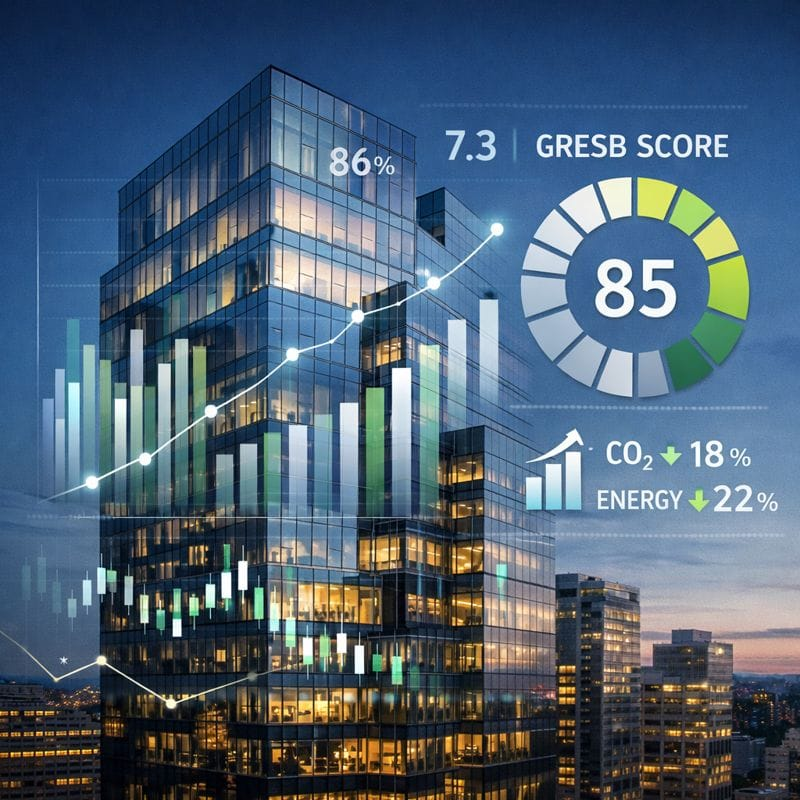
Real estate is entering an era where sustainability defines competitive advantage. Decisions across the value chain are increasingly shaped by environmental, social, and governance performance. Capital providers are aligning investment strategies with responsible outcomes, occupiers are prioritising efficient and resilient spaces, and regulatory scrutiny is steadily increasing. This convergence of expectations is pushing real estate companies to move beyond narrative driven ESG and towards data backed performance. Sustainability today is not just about responsibility, but about relevance, risk management, and sustained market leadership.
GRESB: The Global Benchmark for Sustainable Real Assets
Within this evolving landscape, GRESB has emerged as the definitive standard for sustainable real estate leadership. GRESB is an industry-driven organisation that assesses the ESG performance of real assets worldwide. It provides investors, owners, and managers with standardised, comparable, and reliable data to understand how sustainability practices are integrated into their real estate portfolios. Beyond being an assessment tool, GRESB acts as a strategic platform that enhances financial market opportunities, improves risk management, and drives continuous ESG performance improvement.
Sustainability Leadership in 2025
Real estate in 2025 is being shaped by a convergence of factors that are redefining how assets are evaluated, managed, and valued:
- Capital markets are scrutinising climate risk, operational performance, and low carbon transition readiness.
- Tenants’ expectations have shifted towards healthier, more efficient, climate resilient and sustainable buildings.
- Regulators are tightening energy and sustainability disclosure requirements across regions.
- Operating costs such as energy, maintenance, and insurance are becoming more volatile, while climate impacts on assets are increasingly visible.
What Sets GRESB Apart
One of GRESB’s key features is its portfolio-aligned disclosure approach, allowing participants to report on development projects, operating assets, or both.
Unlike many ESG frameworks or assessments, the GRESB Assessment is designed specifically to address the complexity of real estate portfolios. It captures the realities of the sector by covering operational emissions, embodied carbon, tenant driven consumption, and asset level climate exposure.
- Peer based benchmarking
GRESB results are benchmarked against comparable portfolios across regions and asset classes. This comparison encourages organisations to look beyond participation and critically assess how their performance compares with industry leaders.
- Equal focus on management approach and performance outcomes
GRESB evaluates both how sustainability is managed and what outcomes are achieved. It assesses governance structures, strategy, risk management, engagement, and policies alongside measurable results such as energy use, greenhouse gas emissions, water consumption, waste management, green building certifications, and data coverage. This perspective reflects that sustainability leadership requires both strong intent and effective execution.
- Aligning With Global Trends and Regulations
GRESB integrates critical global sustainability priorities net-zero carbon, climate resilience, and sector-specific ESG issues. It aligns with international reporting frameworks, such as the Task Force on Climate-Related Financial Disclosures (TCFD), Global Reporting Initiative (GRI), and Principles for Responsible Investment (PRI).
- Emphasis on evidence
Data gaps remain one of the most significant barriers to sustainability progress. GRESB encourages organisations to improve data completeness, consistency, and auditability. Its evidence-based indicators reflect towards verifiable performance, requiring organisations to substantiate with robust documentation and reliable asset level data.
- A structured cycle for continuous improvement
The annual nature of the GRESB Assessment creates a consistent improvement rhythm. Planning, implementation, measurement, and refinement become embedded across portfolio and asset teams. Over time, this transforms sustainability efforts into a structured change program rather than a one-time compliance exercise.
Each participating company receives a score and ranking that enables peer benchmarking, highlights areas of strength, reveals gaps relative to industry progress, and identifies clear opportunities for improvement.
From Sustainability Performance to Competitive Advantage
The GRESB Assessment translates sustainability performance into meaningful advantages across finance, operations, risk management, and organisational capability.
- Stronger capital confidence
Investors and lenders increasingly expect credible evidence that sustainability is embedded within governance and risk management. Strong GRESB performance demonstrates mature governance, consistent portfolio wide execution, clearer insight into risk exposure, and a defined trajectory on energy and emissions. This credibility builds trust, which can influence financing terms and transaction outcomes.
- Operational performance that can be managed
GRESB strengthens measurement of energy, emissions, water, and waste by improving data coverage and consistency. This enables clearer identification of assets with performance gaps, prioritisation of strategic capital investments, targeted system interventions, and a better understanding of tenant and lease related impacts. Stronger data supports better decisions and more resilient operating performance.
- Risk readiness in a changing climate
Climate risk is already material to asset performance, with heat stress, water scarcity, flooding, and other climate related impacts affecting operations. GRESB promotes structured approaches to physical and transition risk assessment, resilience planning, governance oversight, and integration of sustainability into investment decisions, supporting long term portfolio readiness.
- Portfolio wide alignment
GRESB encourages coordination across sustainability, asset management, operations, finance, procurement, and leadership functions. When coordinated effectively, it strengthens accountability, standardises processes, improves vendor and tenant engagement, and creates a shared language between technical and business teams. This internal alignment becomes a durable strategic capability.
- Credibility, Recognition, and Market Leadership
GRESB rankings, including 5-Star and sector leader ratings, provide public recognition of ESG leadership. These ratings enhance credibility with investors, attract tenants seeking sustainable spaces, and differentiate properties in competitive markets.
Beyond Scoring: Embedding Sustainability into Execution
The GRESB Assessment is not merely a score or rating exercise; it is a strategic framework that supports alignment between sustainability ambition and operational execution. It enables leadership-level clarity by defining asset-specific roadmaps, prioritising material performance metrics, benchmarking against peers, and strengthening internal capabilities to drive continuous improvement.
In 2025, real estate sustainability leadership is defined by the ability to deliver measurable, credible, and repeatable outcomes. GRESB stands out because it equips organisations to embed sustainability into core governance and decision-making, strengthen resilience to climate and operational risks, and build lasting trust with investors, lenders, and tenants.In a landscape where many claim to be sustainable, true leaders are those who can measure progress, manage performance, and demonstrate improvement year after year and GRESB provides the framework to do that.

